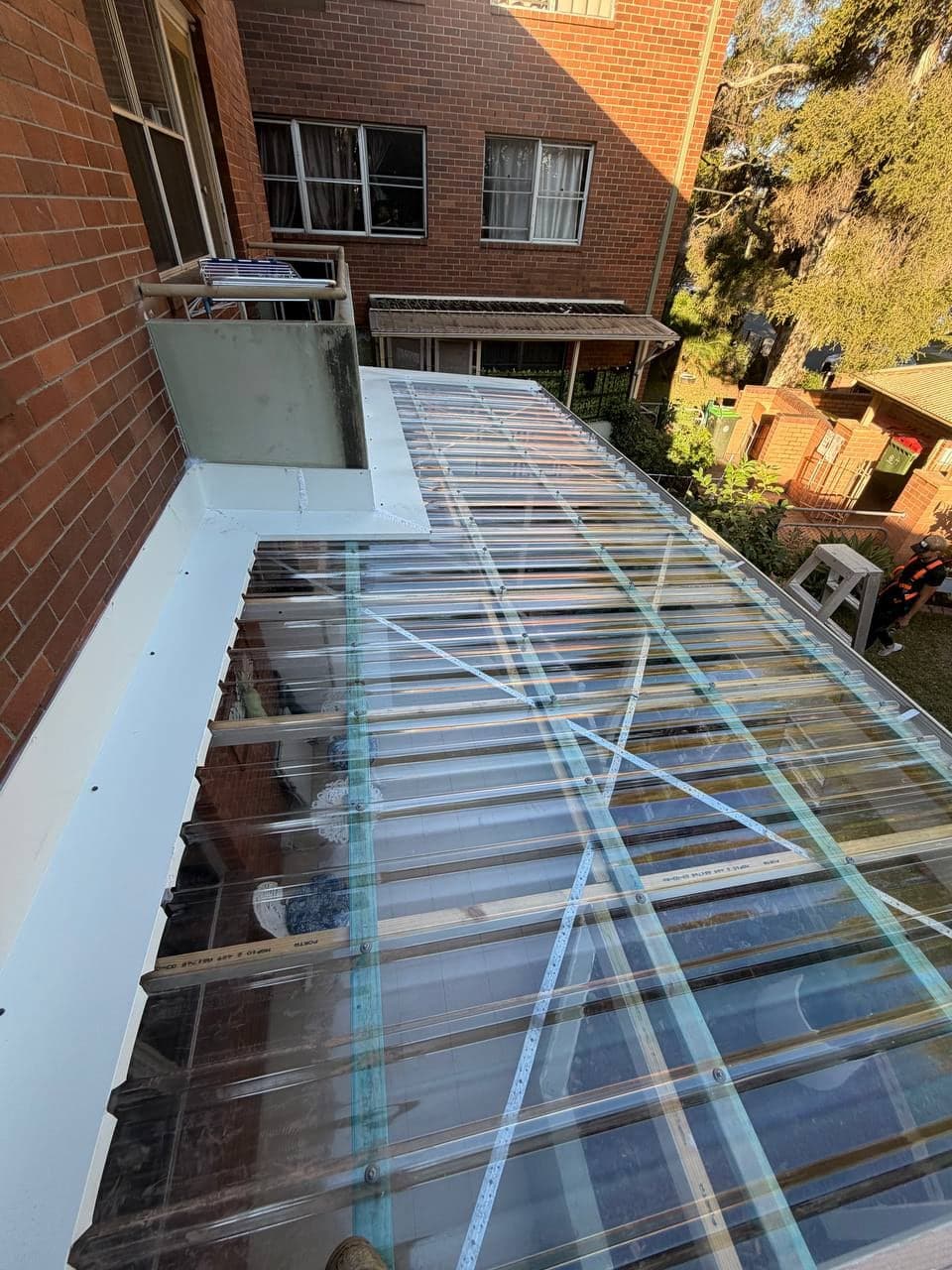
Most patio roof decisions in Sydney come down to the same trade-off: you want the space usable in summer, and you do not want the room behind it turned into a cave. Clear polycarbonate solves the second problem and can make the first one worse. Solid Colorbond does the opposite.
What each one is actually good at
Polycarbonate is a translucent plastic sheet, usually corrugated to match roofing profiles. It passes daylight, weighs very little, and comes in clear, tinted, opal and heat-reducing grades that behave very differently from one another.
Colorbond over a patio is the same steel sheeting used on the house roof. It blocks light completely, handles hail and falling branches far better, and matches the main roof so the extension does not read as an afterthought.
The light problem
The reason people reach for polycarbonate is almost always a window. Roofing over a patio in solid steel can turn a bright kitchen or living room into a dim one, and that is a change you notice every day for years.
Before choosing solid sheeting, look at what is behind the patio. If there is a main window or a glass door under that roofline, either go translucent over that section or expect the room to lose light permanently.
The heat problem
Clear polycarbonate passes a lot of solar heat as well as light. On a west-facing Sydney patio in February, a clear roof can make the space unusable in the afternoon — the exact hours you wanted it for.
Tinted and heat-reducing grades cut this substantially and cost a little more. If you are going translucent on a west or north-west aspect, do not use standard clear. This is the single most common regret we get called back about.
Noise, hail and lifespan
- Rain noise: both are loud. Polycarbonate is sharper and higher-pitched; steel is a deeper drumming. Insulated panel is the genuinely quiet option.
- Hail: Colorbond dents, polycarbonate can crack — and older, UV-degraded polycarbonate cracks much more easily.
- Branches: steel wins comfortably under gum trees.
- Lifespan: quality polycarbonate with a proper UV layer lasts a long time. Cheap sheeting yellows and goes brittle, and once it does the whole run needs replacing.
The mix most people actually want
The arrangement that satisfies the most people is not either/or. Run solid Colorbond over the part you will sit under — the table, the barbecue, the lounge — and translucent sheeting over the rest, particularly the strip nearest the house where the windows are.
You get shade where you are sitting, daylight into the room behind, and a roof that still matches the house. It costs marginally more in flashing work where the two materials meet, and it is worth it.
Getting the flashing right
Where a patio roof meets the house is where these jobs leak. The sheeting has to be flashed properly under the existing roof or wall cladding, not sealed on top with silicone and hope. If a quote does not mention flashing at the junction, ask what happens there.
We build patio, pergola and carport roofs across Sydney in Colorbond, polycarbonate and combinations of both, and we are happy to talk you out of clear sheeting on a west-facing deck. Licensed in NSW (471250C), $20 million public liability, 10-year workmanship guarantee in writing.
Frequently Asked Questions
Does a polycarbonate patio roof make the area hot?
Is rain noisy on a polycarbonate roof?
Can you mix polycarbonate and Colorbond on one roof?
Practical next steps
Find the right roofing help
Explore services related to this guide, or check whether Crown Roofers works in your area.
Crown Roofers Team
Crown Roofers is a NSW-licensed Sydney roofing contractor with $20M public liability and a written 10-year workmanship guarantee.